

DatAgro: SMS-Based Agricultural Information for Rural Chile
How we achieved 85% adoption among one of the hardest-to-reach populations in agricultural development.
Executive summary
Between 2008 and 2010, DatAgro delivered daily agricultural information by SMS to 400 small-scale farmers in Chile's VI Region – achieving an unprecedented 85% adoption rate among a population aged 50+ with basic education and no prior technology experience. In its time, DatAgro was recognized around the world as a pioneering example of mobile technology and innovation working directly with smallholder farmers.
This success came from careful, manual content creation, rigorous community engagement, and persistent problem-solving. The project proved that technology adoption is not about device capability – it is about solving real problems for real people in ways that fit their actual lives. This case study documents how DatAgro worked, what we learned, and the operational constraints that shaped it.
The problem: an information gap in rural agriculture
Chile's small-scale farming communities – particularly in the VI Region (O'Higgins) – faced a persistent information poverty. The information advantage sat with intermediaries, and it cost farmers real income at every harvest.
What farmers lacked
- Real-time market prices for their crops
- Weather forecasts and seasonal alerts
- Agricultural innovations and techniques
- Pest and disease management guidance
- Access to cooperative announcements
What they had
- Basic SMS-capable phones (not smartphones)
- An organized cooperative – Coopeumo, 400 members
- Geographic concentration in a rural area
- Genuine economic need for better information
The technology to reach farmers existed (SMS), the users wanted information, and the cooperative structure could distribute it. No one had systematically connected these three elements.
The solution: SMS-based information delivery
We built DatAgro on a deceptively simple principle: deliver one valuable piece of information per day via SMS – no navigation required, works on any phone.
Technical architecture
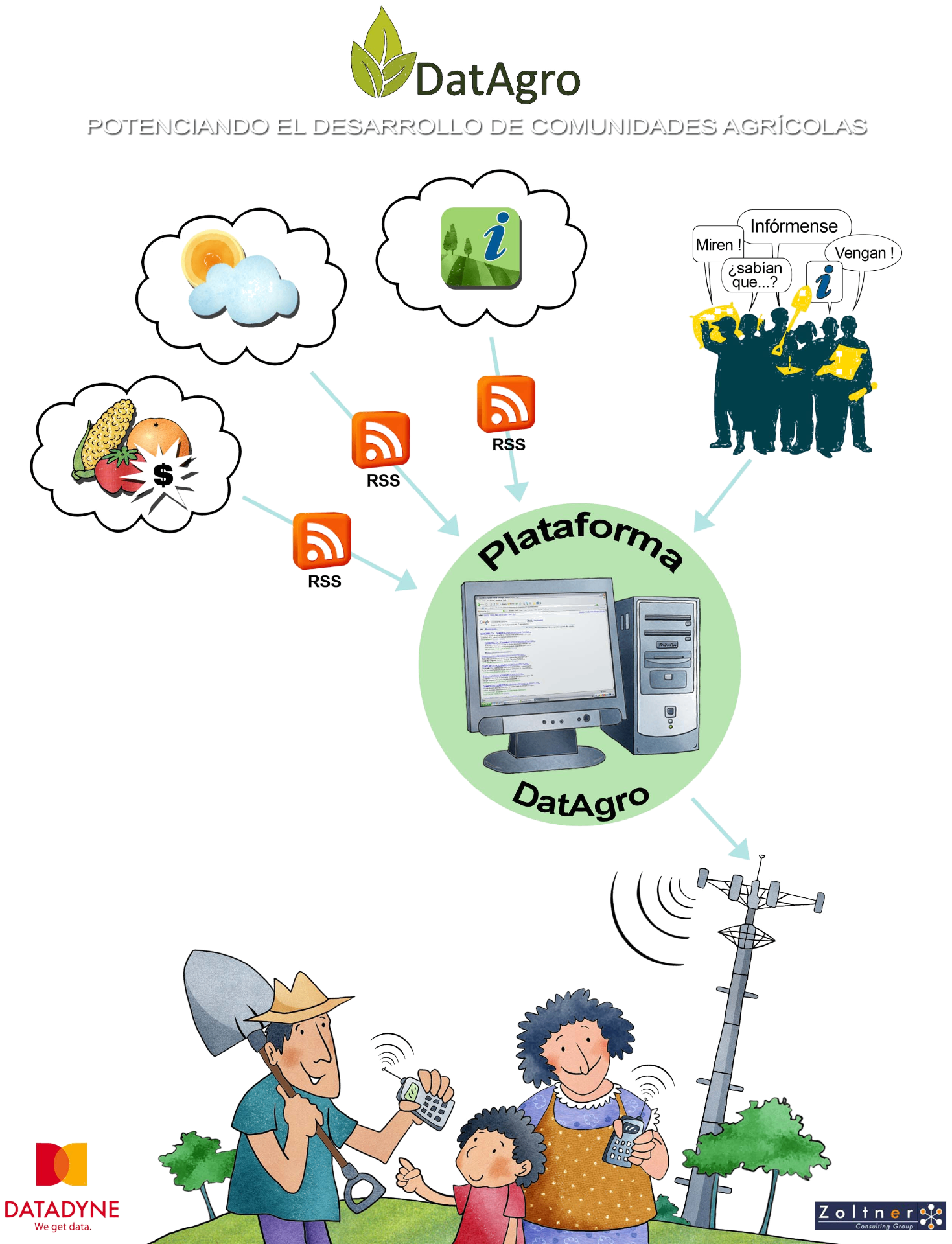
DatAgro ran on DataDyne's Mobile Information Platform (MIP): a web-based administration interface, SMS delivery through mobile operator Entel PCS, message scheduling and subscriber management, and two-way SMS so farmers could query the system as well as receive alerts. One message went out each morning before farm work – 100–160 characters covering prices, weather, techniques, pest alerts, and cooperative announcements.
The labor behind the simplicity
Creating DatAgro's simplicity required significant, sustained human effort. Every message was written by agricultural experts and cooperative coordinators – not generated automatically. The cooperative coordinator, Bernarda Labarca, monitored daily prices across 10+ crop types, selected 3–5 candidate messages, chose the single most valuable one to send, kept records so farmers could reference messages later, and answered farmer queries by SMS.
Each message required human judgment about what farmers actually needed to know on that particular day. Content curation was never a technical problem – it was a domain-expertise problem, and it demanded agricultural knowledge at every step.
Implementation: five phases
DatAgro moved from concept to sustained operation over roughly eighteen months, with the third phase – white launch and testing – carrying most of the real learning.
ZCG and DataDyne designed the system architecture, met with Coopeumo to understand farmer information needs, established content-selection criteria, and partnered with FIA for funding and agricultural expertise.
Recruited an initial 30 farmers, designed message templates and content standards, secured the Entel PCS partnership, and identified content sources across FIA, market databases, and weather services.
Where the real work happened. Messages went to 30 farmers who told us what was useful; we adjusted daily. We learned shorter, more specific messages beat comprehensive ones – and surfaced the constraints that shaped everything: content sourcing took time, personalization was impossible, and scale was limited by human capacity.
Expanded to 200+ farmers from Coopeumo, stabilized daily delivery, built an archive of 500+ messages, and developed standardized message templates.
A comprehensive evaluation of adoption, usage, and impact; standardized content for replication; and a toolkit documenting challenges, solutions, and lessons learned.
The results: unprecedented adoption
Among farmers aged 50+, with primary-school education, no prior technology experience, no internet connectivity, and real skepticism about "technology solutions," 85% actively and sustainably adopted the system. In a context where people could simply ignore SMS messages, that number is the one that mattered – farmers chose to stay engaged.
Usage and behavioral change
Farmers checked messages daily, saved them for seasonal reference, and built habits around the morning delivery time. Information reshaped decisions: when price alerts flagged favorable tomato prices at seasonal peak, farmers shifted harvest timing to capture premiums. Cooperative meetings began to open with "the SMS said…" as farmers used shared information to make collective decisions.
When external funding ended, the system kept running. Coopeumo absorbed DatAgro into cooperative operations – demonstrating that the cooperative structure, not the technology, sustained the initiative beyond its initial funding.
Awards & international recognition
DatAgro's achievement resonated well beyond Chile, drawing national press coverage and international recognition in 2009–2010.
Key learnings
Five principles carried out of DatAgro that shape how we approach rural technology today.
Rural populations don't reject technology out of inability – they reject irrelevant technology. When information addresses real needs through trusted channels, adoption follows.
The constraints – one SMS a day, no navigation – forced discipline about content quality. Being limited to one message made us choose the most valuable one.
You cannot automate the judgment of what a farmer needs to know today. It requires understanding local crops, seasons, markets, and decision-making.
Vendor subscriptions and project grants both ran out. Embedding DatAgro in the cooperative's own operations is what made it last.
One coordinator can curate for ~200 farmers. Reaching 10,000 needs 50 coordinators – the human resource, not the platform, is the ceiling.
Project at a glance
| Metric | Result |
|---|---|
| Adoption rate | 85% among pilot farmers |
| Geographic focus | VI Region (O'Higgins), Chile |
| Scale reached | 400 farmers in the Coopeumo cooperative |
| Project duration | 2+ years (2008–2010) |
| Messages created | 500+ curated SMS messages |
| International awards | Multiple awards & a 2009 international finalist |
| Technology | SMS via Mobile Information Platform (MIP) |
| Partners | DataDyne, Coopeumo, FIA, ZCG, Entel PCS |
Appendix: the content-creation challenge
To illustrate the labor behind DatAgro's simplicity, consider a single day in the coordinator's routine. This cycle, repeated for more than two years, built the archive that made the service work.
Morning: sourcing
- Check real-time prices – tomatoes, potatoes, lettuce, beans
- Review the VI Region weather forecast
- Scan research alerts: techniques, pest outbreaks, innovations
- Read farmer feedback from previous days
- Consult agricultural advisors on today's relevance
Midday: selection & send
- Select 3–5 candidate messages
- Choose the single most valuable one
- Draft it in 100–160-character SMS format
- Review for accuracy, then send at the set time
- Monitor delivery and answer farmer queries
The technology was relatively simple; the implementation was labor-intensive. The limit on scale wasn't the platform – it was the agricultural expertise and daily coordination required to curate short message content. Message quality mattered more than quantity, and local expertise more than centralized systems.
Case study published July 2026 · Project period 2008–2010 · The Zoltner Consulting Group