
Anti-Grooming Classifier & Chatbot
Detecting online grooming in chats with children


Online grooming is hard to detect precisely because it looks like ordinary conversation. A groomer builds trust first, and the words that would matter to a filter arrive late, if they arrive at all. Most child-safety technology scans for known illegal material, which only works once the harm already exists in a file somewhere. I wanted to know whether the shape of the conversation itself could be recognized early enough to interrupt it.
So I conceived this project and ran it as product manager across two development cycles, in 2020 and again over the winter of 2022. It was a collaboration between Save the Children and Omdena; the prototype classifier that came out of it was trained on real, known grooming conversations, and the project also produced a chatbot.
What product management meant here
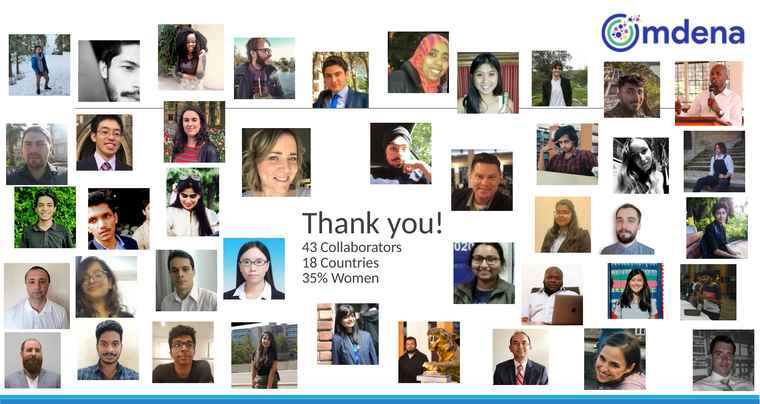
I was the product manager on this, not the engineer. The models were built by the distributed community of AI engineers that Omdena convenes, 43 of them from 18 countries in the first cycle and about fifty in the second. What I brought was the problem, the specification, and the judgment calls a volunteer engineering team should not have to make alone on a child-protection product.
In practice that meant writing the brief the second cycle was built against: the annotation target, the risk taxonomy, the requirement that the classifier read conversations rather than isolated sentences, the decision to ship as an API, and the form factor, a quiet always-on check inside the chat rather than a dashboard somebody has to remember to open. It meant running the data operation that made any of it possible. And it meant deciding what the system should do in the moment it believes a child is being groomed.
It also meant keeping the work alive between cycles and setting the road ahead: extending the data to underrepresented languages and regions, moving from sentence-level scoring to contextual analysis, controlled deployment with trusted partners before any consumer platform, audit trails so that a classifier's decisions can be reviewed after the fact, and the privacy and ethics guidelines that have to exist before a tool like this touches a real conversation.
Phase one: mapping the problem
The first challenge ran over two months in 2020 and brought together 43 collaborators from 18 countries, just over a third of them women, working in nine parallel teams under Omdena's bottom-up model. It produced six datasets, five research reports, and five working prototypes.
The teams came at online violence against children from several directions at once: news coverage collected from media outlets across 22 countries; survivors' own accounts drawn from forums and reporting; conversation patterns on social platforms; a risk classifier for video games built from parent and player reviews; a neural search engine over the academic literature; and a catalog of 113 online-safety education materials sorted for parents, teachers, and children. We brought in outside domain experts from SafeToNet and Human Rights First as the work progressed.
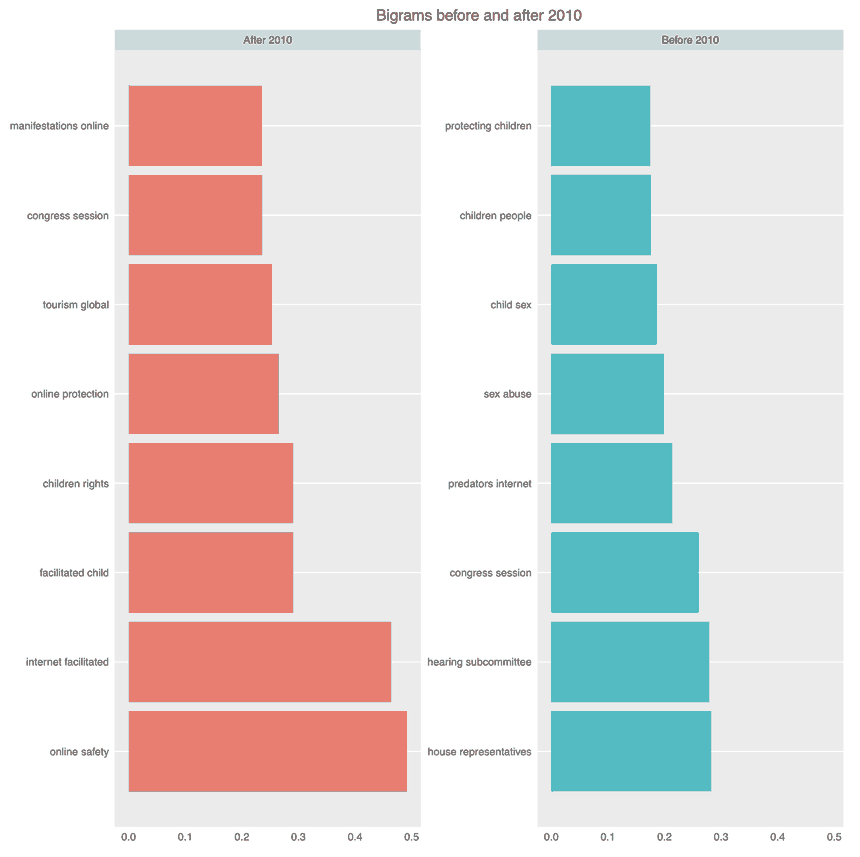
The literature analysis turned up one pattern worth repeating. Comparing the two-word phrases that dominated published research before and after 2010, the vocabulary shifts from prosecution to protection: “house representatives”, “hearing subcommittee” and “predators internet” give way to “online safety”, “internet facilitated” and “children rights”. The field changed what it understood itself to be doing.
Two pieces mattered most. One was an educational chatbot that teaches children about cyberbullying, unwanted contact, and online risk, built on intents drawn from Australia's eSafety Commissioner and Common Sense Media. The other was the predator-analysis work that became the classifier.
Building a dataset that did not exist
No structured dataset of grooming conversations was available, so the team built one. Working from the Perverted Justice archive, a record of decoy conversations collected between 2003 and 2019, collaborators assembled more than 800,000 messages and hand-tagged over 17,000 lines by risk level. The labeling alone took more than 840 volunteer hours. It is unglamorous work, and it is the reason everything after it was possible. Close to half the first challenge's time went into building and parsing that dataset.
Annotation is where a project like this quietly succeeds or fails, so the second cycle treated it as an operation rather than a chore. Labelers worked to a written inter-annotator guide, so that “potentially risky” meant the same thing to everyone; every conversation was assigned an annotator and a separate reviewer; and the team built spreadsheet macros to take the mechanical work out of tagging blocks of messages. The target was a hundred thousand annotated sentences.
Phase two: toward a deployable classifier
In late 2022, Save the Children and Omdena returned to the problem with a narrower goal: a classifier accurate enough to run inside a live chat. That second challenge ran ten weeks, from November 2022 to February 2023.
The main advance was in how grooming was described to the model. The first pass had rated single sentences on a flat three-point risk scale. The second grounded annotation in the recognized stages of grooming, relationship forming, risk assessment, exclusivity, sexual content, and arranging to meet, so that a block of conversation could be read as a trajectory rather than as a series of isolated lines. A written inter-annotator guide and paired annotator and reviewer assignments kept judgments consistent across a distributed team.
On the modeling side, the team surveyed more than 40 transformer architectures and compared 25 fine-tuned runs before settling on BERT as its baseline, then applied contrastive and noise-aware training to correct for labeling bias. The result was packaged as a prediction API with a scheduled data-ingestion pipeline behind it, designed to sit inside a chat the way a writing assistant sits inside a text box: always on, and quiet until it is needed.
How detection works
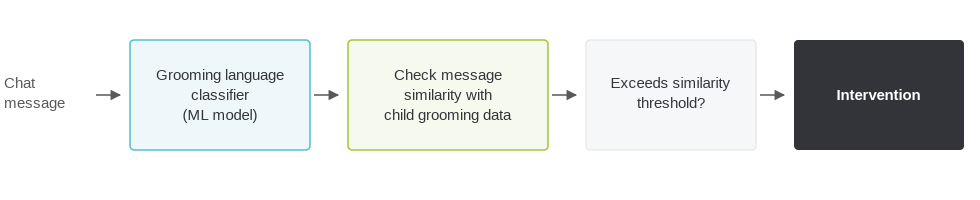
The design is deliberately simple at the point of use. Each message is scored against patterns learned from known grooming conversations. When a conversation crosses a similarity threshold, the system triggers an intervention, and what that intervention is depends on the platform: warn the child through a chatbot without alerting the groomer, bring in a human moderator, or end the chat.
Where that threshold sits matters as much as the model does. A false positive interrupts an innocent conversation; a false negative leaves a child in a dangerous one. That trade-off is a product decision rather than a technical one, and it belongs with the platform and its child-protection advisers, not with the model alone.
One early decision still shapes the design. The first working chatbot was built to run locally and offline rather than in the cloud, specifically to narrow the privacy and legal exposure that comes with routing children's private conversations through someone else's servers. That constraint is harder to engineer around, and it is the right default for a product whose whole purpose is protecting the person on the other end of the chat.
The prototype was named to IRCAI's Global Top 100 list of AI projects addressing the UN Sustainable Development Goals in 2021, recognized under SDG 3 and SDG 4. IRCAI is the International Research Centre on Artificial Intelligence, under the auspices of UNESCO.
It remains a good example of the harder half of child-safety technology: not flagging known illegal content, but modeling patterns of behavior, carefully, and with a clear sense of what a wrong answer costs.